The abstract table class. More...
#include <table.h>
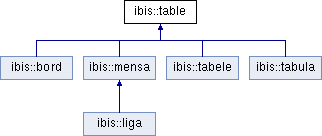
Classes | |
| class | cursor |
| Cursor class for row-wise data accesses. More... | |
| struct | row |
| A simple struct for storing a row of a table. More... | |
Public Types | |
| typedef ibis::array_t< void * > | bufferArray |
| A list to hold the in-memory buffers. More... | |
| typedef std::map< const char *, ibis::TYPE_T, ibis::lessi > | namesTypes |
| An associative array of names and types. | |
| typedef ibis::array_t< const char * > | stringArray |
| A list of strings. More... | |
| typedef std::vector< const char * > | stringVector |
| typedef ibis::array_t< ibis::TYPE_T > | typeArray |
| A list of data types. | |
Public Member Functions | |
| virtual int | addPartition (const char *) |
| Add a data partition defined in the named directory. More... | |
| virtual int | backup (const char *dir, const char *tname=0, const char *tdesc=0) const =0 |
| Write the current content to the specified output directory in the raw binary format. More... | |
| virtual stringArray | columnNames () const =0 |
| virtual typeArray | columnTypes () const =0 |
| !< Return column names. | |
| virtual cursor * | createCursor () const =0 |
Create a cursor object to perform row-wise data access. | |
| virtual void | describe (std::ostream &) const =0 |
| !< Return data types. More... | |
| virtual const char * | description () const |
| Free text description. May return a null pointer. | |
| virtual int | dropPartition (const char *) |
| Remove the named data partition from this data table. More... | |
| virtual int | dump (std::ostream &out, const char *del=", ") const =0 |
| Print the values in ASCII form to the specified output stream. More... | |
| virtual int | dump (std::ostream &out, uint64_t nr, const char *del=", ") const =0 |
| Print the first nr rows. | |
| virtual int | dump (std::ostream &out, uint64_t offset, uint64_t nr, const char *del=", ") const =0 |
| Print nr rows starting with row offset. More... | |
| virtual void | dumpNames (std::ostream &out, const char *del=", ") const =0 |
| Print all column names on one line. | |
| virtual void | estimate (const char *cond, uint64_t &nmin, uint64_t &nmax) const =0 |
| Estimate the number of rows satisfying the selection conditions. More... | |
| virtual void | estimate (const ibis::qExpr *cond, uint64_t &nmin, uint64_t &nmax) const =0 |
| Estimate the number of rows satisfying the selection conditions. More... | |
| virtual int | getPartitions (ibis::constPartList &) const |
| Retrieve the list of partitions. | |
| virtual table * | groupby (const stringArray &) const =0 |
| Perform aggregate functions on the current table. More... | |
| virtual table * | groupby (const char *) const |
| Perform a group-by operation. More... | |
| virtual const char * | name () const |
| Name of the table. More... | |
| virtual uint32_t | nColumns () const =0 |
| The number of columns in this table. | |
| virtual uint64_t | nRows () const =0 |
| The number of rows in this table. | |
| virtual void | orderby (const stringArray &)=0 |
| Reorder the rows. More... | |
| virtual void | orderby (const stringArray &, const std::vector< bool > &)=0 |
| virtual void | orderby (const char *) |
| Reorder the rows. The column names are separated by commas. | |
| virtual void | reverseRows ()=0 |
| Reverse the order of the rows. | |
| virtual table * | select (const char *sel, const char *cond) const =0 |
| Given a set of column names and a set of selection conditions, compute another table that represents the selected values. More... | |
| virtual table * | select (const char *sel, const ibis::qExpr *cond) const |
| Process the selection conditions and generate another table to hold the answer. More... | |
| virtual | ~table () |
| Destructor. | |
| virtual int | buildIndex (const char *colname, const char *option=0)=0 |
| The following functions deal with auxillary data for accelerating query processing, primarily for building indexes. More... | |
| virtual int | buildIndexes (const char *options)=0 |
| Create indexes for every column of the table. More... | |
| virtual int | buildIndexes (const stringArray &)=0 |
| The following functions deal with auxillary data for accelerating query processing, primarily for building indexes. More... | |
| virtual const char * | indexSpec (const char *colname=0) const =0 |
| Retrieve the current indexing option. More... | |
| virtual void | indexSpec (const char *opt, const char *colname=0)=0 |
| Replace the current indexing option. More... | |
| virtual int | mergeCategories (const stringArray &) |
| Merge the dictionaries of categorical value from different data partitions. More... | |
| virtual int64_t | getColumnAsBytes (const char *cname, char *vals, uint64_t begin=0, uint64_t end=0) const =0 |
| Retrieve all values of the named column. More... | |
| virtual int64_t | getColumnAsUBytes (const char *cname, unsigned char *vals, uint64_t begin=0, uint64_t end=0) const =0 |
| Retrieve all values of the named column. More... | |
| virtual int64_t | getColumnAsShorts (const char *cname, int16_t *vals, uint64_t begin=0, uint64_t end=0) const =0 |
| Retrieve all values of the named column. More... | |
| virtual int64_t | getColumnAsUShorts (const char *cname, uint16_t *vals, uint64_t begin=0, uint64_t end=0) const =0 |
| Retrieve all values of the named column. More... | |
| virtual int64_t | getColumnAsInts (const char *cname, int32_t *vals, uint64_t begin=0, uint64_t end=0) const =0 |
| Retrieve all values of the named column. More... | |
| virtual int64_t | getColumnAsUInts (const char *cname, uint32_t *vals, uint64_t begin=0, uint64_t end=0) const =0 |
| Retrieve all values of the named column. More... | |
| virtual int64_t | getColumnAsLongs (const char *cname, int64_t *vals, uint64_t begin=0, uint64_t end=0) const =0 |
| Retrieve all values of the named column. More... | |
| virtual int64_t | getColumnAsULongs (const char *cname, uint64_t *vals, uint64_t begin=0, uint64_t end=0) const =0 |
| Retrieve all values of the named column. More... | |
| virtual int64_t | getColumnAsFloats (const char *cname, float *vals, uint64_t begin=0, uint64_t end=0) const =0 |
| Retrieve all values of the named column. More... | |
| virtual int64_t | getColumnAsDoubles (const char *cname, double *vals, uint64_t begin=0, uint64_t end=0) const =0 |
| Retrieve all values of the named column. More... | |
| virtual int64_t | getColumnAsDoubles (const char *cname, std::vector< double > &vals, uint64_t begin=0, uint64_t end=0) const =0 |
| Retrieve all values of the named column. More... | |
| virtual int64_t | getColumnAsStrings (const char *cname, std::vector< std::string > &vals, uint64_t begin=0, uint64_t end=0) const =0 |
| Retrieve the null-terminated strings as a vector of std::string objects. More... | |
| virtual int64_t | getColumnAsOpaques (const char *cname, std::vector< ibis::opaque > &vals, uint64_t begin=0, uint64_t end=0) const =0 |
| Retrieve the blobs as ibis::opaque objects. More... | |
| virtual double | getColumnMin (const char *cname) const =0 |
| Compute the minimum of all valid values in the name column. More... | |
| virtual double | getColumnMax (const char *cname) const =0 |
| Compute the maximum of all valid values in the name column. More... | |
| virtual long | getHistogram (const char *constraints, const char *cname, double begin, double end, double stride, std::vector< uint32_t > &counts) const =0 |
| virtual long | getHistogram2D (const char *constraints, const char *cname1, double begin1, double end1, double stride1, const char *cname2, double begin2, double end2, double stride2, std::vector< uint32_t > &counts) const =0 |
Compute a two-dimension histogram on columns cname1 and cname2. More... | |
| virtual long | getHistogram3D (const char *constraints, const char *cname1, double begin1, double end1, double stride1, const char *cname2, double begin2, double end2, double stride2, const char *cname3, double begin3, double end3, double stride3, std::vector< uint32_t > &counts) const =0 |
| Compute a three-dimensional histogram on the named columns. More... | |
Static Public Member Functions | |
| static void * | allocateBuffer (ibis::TYPE_T, size_t) |
| Allocate a buffer of the specified type and size. | |
| static int64_t | computeHits (const ibis::constPartList &parts, const char *cond) |
| Compute the number of rows satisfying the specified conditions. More... | |
| static int64_t | computeHits (const ibis::constPartList &parts, const ibis::qExpr *cond) |
| Compute the number of rows satisfying the specified query expression. More... | |
| static void | consecrateName (char *) |
| Remove unallowed characters from the given string to produce a valid column name. More... | |
| static ibis::table * | create (ibis::part &) |
| Create a simple of container of a partition. More... | |
| static ibis::table * | create (const ibis::partList &) |
| Create a container of externally managed data partitions. More... | |
| static ibis::table * | create (const char *dir) |
| Create a table object from the specified data directory. More... | |
| static ibis::table * | create (const char *dir1, const char *dir2) |
| Create a table object from a pair of data directories. More... | |
| static void | freeBuffer (void *buffer, ibis::TYPE_T type) |
| Freeing a buffer for storing in-memory values. More... | |
| static void | freeBuffers (bufferArray &, typeArray &) |
| Freeing a list of buffers. More... | |
| static bool | isValidName (const char *) |
| Is the given string a valid FastBit name for a data column? | |
| static void | parseNames (char *in, stringVector &out) |
| Parse the incoming string into a set of names. More... | |
| static void | parseNames (char *in, stringArray &out) |
| Parse the incoming string into a set of names. More... | |
| static void | parseOrderby (char *in, stringArray &out, std::vector< bool > &direc) |
| Parse the incoming string as an order-by clause. More... | |
| static table * | select (const ibis::constPartList &parts, const char *sel, const char *cond) |
| Perform the select operation on a list of data partitions. More... | |
| static table * | select (const ibis::constPartList &parts, const char *sel, const ibis::qExpr *cond) |
| Perform select operation using a user-supplied query expression. More... | |
Protected Member Functions | |
| table () | |
| !< Description of the table. More... | |
| table (const char *na, const char *de) | |
| Constructor. Use the user-supplied name and description. | |
Protected Attributes | |
| std::string | desc_ |
| !< Name of the table. | |
| std::string | name_ |
Detailed Description
The abstract table class.
This is an abstract base class that defines the common operations on a data table. Conceptually, data records in a table is organized into rows and columns. A query on a table produces a filtered version of the table. In many database systems this is known as a view of a table. All data tables and views are logically treated as specialization of this class. An example of using this class can be found in examples/thula.cpp.
Member Typedef Documentation
| typedef ibis::array_t<void *> ibis::table::bufferArray |
A list to hold the in-memory buffers.
The void* is either ibis::array_t* or std::vector<std::string> depending on the underlying data type. Typically used together with typeArray.
| typedef ibis::array_t<const char*> ibis::table::stringArray |
A list of strings.
- Note
- The pointers are expected to point to names stored internally. The caller should not attempt to free these pointers.
Constructor & Destructor Documentation
|
inlineprotected |
!< Description of the table.
The default constructor.
Member Function Documentation
|
inlinevirtual |
Add a data partition defined in the named directory.
Upon successful completion, it returns the number of data partitions found, otherwise it returns a negative number to indicate failure.
If the name of the directory is a nil pointer, this function will examine the entries in the configuration parameters to identify locations of data partitions. This matches the behavior of ibis::table::create.
- Note
- The intent is for this function to recursively examine its subdirecories when possible. Therefore it may find an arbitrary number of data partitions.
Reimplemented in ibis::liga, and ibis::mensa.
|
pure virtual |
Write the current content to the specified output directory in the raw binary format.
May optionally overwrite the name and description of the table.
Implemented in ibis::tabele, ibis::bord, ibis::tabula, and ibis::mensa.
|
pure virtual |
The following functions deal with auxillary data for accelerating query processing, primarily for building indexes.
Create the index for the named column. The existing index will be replaced. If an indexing option is not specified, it will use the internally recorded option for the named column or the table containing the column.
- Note
- Unless there is a specific instruction to not index a column, the querying functions will automatically build indexes as necessary. However, as building an index is relatively expensive, building an index on a column is on average about four or five times as expensive as reading the column from disk, this function is provided to build indexes beforehand.
Implemented in ibis::tabele, ibis::bord, ibis::tabula, and ibis::mensa.
|
pure virtual |
Create indexes for every column of the table.
Existing indexes will be replaced. If an indexing option is not specified, the internally recorded options will be used.
- See also
- buildIndex
Implemented in ibis::tabele, ibis::bord, ibis::tabula, and ibis::mensa.
|
pure virtual |
The following functions deal with auxillary data for accelerating query processing, primarily for building indexes.
Create the index for the named column. The existing index will be replaced. If an indexing option is not specified, it will use the internally recorded option for the named column or the table containing the column.
- Note
- Unless there is a specific instruction to not index a column, the querying functions will automatically build indexes as necessary. However, as building an index is relatively expensive, building an index on a column is on average about four or five times as expensive as reading the column from disk, this function is provided to build indexes beforehand.
Implemented in ibis::tabele, ibis::bord, ibis::tabula, and ibis::mensa.
|
static |
Compute the number of rows satisfying the specified conditions.
It iterates through all data partitions to compute the number of hits.
References ibis::countQuery::evaluate(), ibis::countQuery::getNumHits(), ibis::countQuery::setPartition(), and ibis::countQuery::setWhereClause().
Referenced by ibis::mensa::computeHits(), select(), ibis::mensa::select2(), ibis::filter::sift(), ibis::filter::sift2(), and ibis::filter::sift2S().
|
static |
Compute the number of rows satisfying the specified query expression.
It iterates through all data partitions to compute the number of hits.
References ibis::countQuery::evaluate(), ibis::countQuery::getNumHits(), ibis::countQuery::setPartition(), and ibis::countQuery::setWhereClause().
|
static |
Remove unallowed characters from the given string to produce a valid column name.
This function will not allocate new memory, therefore, if the incoming string is nil, nothing is done.
|
static |
Create a simple of container of a partition.
The objective is to make the functions of this class available. The caller retains the ownership of the data partition.
|
static |
Create a container of externally managed data partitions.
The objective is to make the functions of this class available. The caller retains the ownership of the data partition.
|
static |
Create a table object from the specified data directory.
If the incoming directory name is nil or an empty string, it attempts to use the directories specified in the configuration files.
If the argument is a nil pointer, it will examine configuration parameters to find locations of data patitions.
|
static |
Create a table object from a pair of data directories.
The intention of maintaining two sets of data files is to process queries using one set while accept new data records with the other. However, such functionality is not currently implemented!
|
pure virtual |
!< Return data types.
Print a description of the table to the specified output stream.
Implemented in ibis::tabele, ibis::bord, ibis::mensa, and ibis::tabula.
Referenced by ibis::jNatural::select(), ibis::jRange::select(), and ibis::filter::sift0S().
|
inlinevirtual |
Remove the named data partition from this data table.
The incoming argument is expected to the name of the data partition.
- Note
- If it is not a name of any data partition, we check if it is the name of the data directory. In the process of matching directory names, we will match the leading port of the directory name only. This allows the data partitions added through a single call of addPartition to be dropped with a single call to this function using the same arguement.
Reimplemented in ibis::mensa.
|
pure virtual |
Print the values in ASCII form to the specified output stream.
The default delimiter is coma (","), which produces Comma-Separated-Values (CSV).
Implemented in ibis::tabele, ibis::bord, ibis::mensa, and ibis::tabula.
|
pure virtual |
Print nr rows starting with row offset.
Note that the row number starts with 0, i.e., the first row is row 0.
Implemented in ibis::tabele, ibis::bord, ibis::mensa, and ibis::tabula.
|
pure virtual |
Estimate the number of rows satisfying the selection conditions.
The number of rows is between [nmin, nmax] (inclusive).
Implemented in ibis::tabele, ibis::bord, ibis::tabula, and ibis::mensa.
|
pure virtual |
Estimate the number of rows satisfying the selection conditions.
The number of rows is between [nmin, nmax] (inclusive).
Implemented in ibis::tabele, ibis::bord, ibis::tabula, and ibis::mensa.
|
static |
Freeing a buffer for storing in-memory values.
List of actual data types for the incoming buffer, which is assumed to be ibis::bord::column::buffer:
- ibis::BIT: ibis::bitvector
- ibis::OID: ibis::array_t<ibis::rid_t>
- ibis::BYTE: ibis::array_t<signed char>
- ibis::UBYTE: ibis::array_t<unsigned char>
- ibis::SHORT: ibis::array_t<int16_t>
- ibis::USHORT: ibis::array_t<uint16_t>
- ibis::INT: ibis::array_t<int32_t>
- ibis::UINT: ibis::array_t<uint32_t>
- ibis::LONG: ibis::array_t<int64_t>
- ibis::ULONG: ibis::array_t<uint64_t>
- ibis::FLOAT: ibis::array_t<float>
- ibis::DOUBLE: ibis::array_t<double>
- ibis::TEXT, ibis::CATEGORY: std::vector<std::string>
References ibis::BIT, ibis::CATEGORY, ibis::DOUBLE, ibis::FLOAT, ibis::INT, ibis::LONG, ibis::OID, ibis::SHORT, ibis::TEXT, ibis::TYPESTRING, ibis::UBYTE, ibis::UINT, ibis::ULONG, and ibis::USHORT.
Referenced by ibis::bord::bord(), ibis::bord::column::~column(), and ibis::jRange::~jRange().
|
static |
Freeing a list of buffers.
- See also
- ibis::table::freeBuffer
References ibis::BIT, ibis::CATEGORY, ibis::array_t< T >::clear(), ibis::DOUBLE, ibis::FLOAT, ibis::INT, ibis::LONG, ibis::OID, ibis::SHORT, ibis::array_t< T >::size(), ibis::TEXT, ibis::TYPESTRING, ibis::UBYTE, ibis::UINT, ibis::ULONG, and ibis::USHORT.
Referenced by ibis::bord::evaluateTerms(), ibis::jNatural::fillResult(), ibis::jRange::fillResult(), ibis::bord::groupbya(), ibis::bord::groupbyc(), ibis::jNatural::select(), ibis::jRange::select(), and ibis::bord::xgroupby().
|
pure virtual |
Retrieve all values of the named column.
The member functions of this class only support access to one column at a time. Use table::cursor class for row-wise accesses.
The arguments begin and end are given in row numbers starting from 0. If begin < end, then rows begin till end-1 are packed into the output array. If 0 == end (i.e., leaving end as the default value), then the values from begin till end of the table is packed into the output array. The default values where both begin and end are 0 define a range covering all rows of the table.
These functions return the number of elements copied upon successful completion, otherwise they return a negative number to indicate failure.
- Note
- For fixed-width data types, the raw pointers are used to point to the values to be returned. In these cases, the caller is responsible for allocating enough storage for the values to be returned.
Implemented in ibis::tabele, ibis::bord, ibis::tabula, and ibis::mensa.
|
pure virtual |
Retrieve all values of the named column.
The member functions of this class only support access to one column at a time. Use table::cursor class for row-wise accesses.
The arguments begin and end are given in row numbers starting from 0. If begin < end, then rows begin till end-1 are packed into the output array. If 0 == end (i.e., leaving end as the default value), then the values from begin till end of the table is packed into the output array. The default values where both begin and end are 0 define a range covering all rows of the table.
These functions return the number of elements copied upon successful completion, otherwise they return a negative number to indicate failure.
- Note
- For fixed-width data types, the raw pointers are used to point to the values to be returned. In these cases, the caller is responsible for allocating enough storage for the values to be returned.
Implemented in ibis::tabele, ibis::bord, ibis::tabula, and ibis::mensa.
|
pure virtual |
Retrieve all values of the named column.
The member functions of this class only support access to one column at a time. Use table::cursor class for row-wise accesses.
The arguments begin and end are given in row numbers starting from 0. If begin < end, then rows begin till end-1 are packed into the output array. If 0 == end (i.e., leaving end as the default value), then the values from begin till end of the table is packed into the output array. The default values where both begin and end are 0 define a range covering all rows of the table.
These functions return the number of elements copied upon successful completion, otherwise they return a negative number to indicate failure.
- Note
- For fixed-width data types, the raw pointers are used to point to the values to be returned. In these cases, the caller is responsible for allocating enough storage for the values to be returned.
Implemented in ibis::tabele, ibis::bord, ibis::tabula, and ibis::mensa.
|
pure virtual |
Retrieve all values of the named column.
The member functions of this class only support access to one column at a time. Use table::cursor class for row-wise accesses.
The arguments begin and end are given in row numbers starting from 0. If begin < end, then rows begin till end-1 are packed into the output array. If 0 == end (i.e., leaving end as the default value), then the values from begin till end of the table is packed into the output array. The default values where both begin and end are 0 define a range covering all rows of the table.
These functions return the number of elements copied upon successful completion, otherwise they return a negative number to indicate failure.
- Note
- For fixed-width data types, the raw pointers are used to point to the values to be returned. In these cases, the caller is responsible for allocating enough storage for the values to be returned.
Implemented in ibis::tabele, ibis::bord, ibis::tabula, and ibis::mensa.
|
pure virtual |
Retrieve all values of the named column.
The member functions of this class only support access to one column at a time. Use table::cursor class for row-wise accesses.
The arguments begin and end are given in row numbers starting from 0. If begin < end, then rows begin till end-1 are packed into the output array. If 0 == end (i.e., leaving end as the default value), then the values from begin till end of the table is packed into the output array. The default values where both begin and end are 0 define a range covering all rows of the table.
These functions return the number of elements copied upon successful completion, otherwise they return a negative number to indicate failure.
- Note
- For fixed-width data types, the raw pointers are used to point to the values to be returned. In these cases, the caller is responsible for allocating enough storage for the values to be returned.
Implemented in ibis::tabele, ibis::bord, ibis::tabula, and ibis::mensa.
|
pure virtual |
Retrieve all values of the named column.
The member functions of this class only support access to one column at a time. Use table::cursor class for row-wise accesses.
The arguments begin and end are given in row numbers starting from 0. If begin < end, then rows begin till end-1 are packed into the output array. If 0 == end (i.e., leaving end as the default value), then the values from begin till end of the table is packed into the output array. The default values where both begin and end are 0 define a range covering all rows of the table.
These functions return the number of elements copied upon successful completion, otherwise they return a negative number to indicate failure.
- Note
- For fixed-width data types, the raw pointers are used to point to the values to be returned. In these cases, the caller is responsible for allocating enough storage for the values to be returned.
Implemented in ibis::tabele, ibis::bord, ibis::tabula, and ibis::mensa.
|
pure virtual |
Retrieve the blobs as ibis::opaque objects.
Only work on the column type BLOB.
Implemented in ibis::tabele, ibis::bord, ibis::tabula, and ibis::mensa.
|
pure virtual |
Retrieve all values of the named column.
The member functions of this class only support access to one column at a time. Use table::cursor class for row-wise accesses.
The arguments begin and end are given in row numbers starting from 0. If begin < end, then rows begin till end-1 are packed into the output array. If 0 == end (i.e., leaving end as the default value), then the values from begin till end of the table is packed into the output array. The default values where both begin and end are 0 define a range covering all rows of the table.
These functions return the number of elements copied upon successful completion, otherwise they return a negative number to indicate failure.
- Note
- For fixed-width data types, the raw pointers are used to point to the values to be returned. In these cases, the caller is responsible for allocating enough storage for the values to be returned.
Implemented in ibis::tabele, ibis::bord, ibis::tabula, and ibis::mensa.
|
pure virtual |
Retrieve the null-terminated strings as a vector of std::string objects.
Both ibis::CATEGORY and ibis::TEXT types can be retrieved using this function.
Implemented in ibis::tabele, ibis::bord, ibis::tabula, and ibis::mensa.
|
pure virtual |
Retrieve all values of the named column.
The member functions of this class only support access to one column at a time. Use table::cursor class for row-wise accesses.
The arguments begin and end are given in row numbers starting from 0. If begin < end, then rows begin till end-1 are packed into the output array. If 0 == end (i.e., leaving end as the default value), then the values from begin till end of the table is packed into the output array. The default values where both begin and end are 0 define a range covering all rows of the table.
These functions return the number of elements copied upon successful completion, otherwise they return a negative number to indicate failure.
- Note
- For fixed-width data types, the raw pointers are used to point to the values to be returned. In these cases, the caller is responsible for allocating enough storage for the values to be returned.
Implemented in ibis::tabele, ibis::bord, ibis::tabula, and ibis::mensa.
|
pure virtual |
Retrieve all values of the named column.
The member functions of this class only support access to one column at a time. Use table::cursor class for row-wise accesses.
The arguments begin and end are given in row numbers starting from 0. If begin < end, then rows begin till end-1 are packed into the output array. If 0 == end (i.e., leaving end as the default value), then the values from begin till end of the table is packed into the output array. The default values where both begin and end are 0 define a range covering all rows of the table.
These functions return the number of elements copied upon successful completion, otherwise they return a negative number to indicate failure.
- Note
- For fixed-width data types, the raw pointers are used to point to the values to be returned. In these cases, the caller is responsible for allocating enough storage for the values to be returned.
Implemented in ibis::tabele, ibis::bord, ibis::tabula, and ibis::mensa.
|
pure virtual |
Retrieve all values of the named column.
The member functions of this class only support access to one column at a time. Use table::cursor class for row-wise accesses.
The arguments begin and end are given in row numbers starting from 0. If begin < end, then rows begin till end-1 are packed into the output array. If 0 == end (i.e., leaving end as the default value), then the values from begin till end of the table is packed into the output array. The default values where both begin and end are 0 define a range covering all rows of the table.
These functions return the number of elements copied upon successful completion, otherwise they return a negative number to indicate failure.
- Note
- For fixed-width data types, the raw pointers are used to point to the values to be returned. In these cases, the caller is responsible for allocating enough storage for the values to be returned.
Implemented in ibis::tabele, ibis::bord, ibis::tabula, and ibis::mensa.
|
pure virtual |
Retrieve all values of the named column.
The member functions of this class only support access to one column at a time. Use table::cursor class for row-wise accesses.
The arguments begin and end are given in row numbers starting from 0. If begin < end, then rows begin till end-1 are packed into the output array. If 0 == end (i.e., leaving end as the default value), then the values from begin till end of the table is packed into the output array. The default values where both begin and end are 0 define a range covering all rows of the table.
These functions return the number of elements copied upon successful completion, otherwise they return a negative number to indicate failure.
- Note
- For fixed-width data types, the raw pointers are used to point to the values to be returned. In these cases, the caller is responsible for allocating enough storage for the values to be returned.
Implemented in ibis::tabele, ibis::bord, ibis::tabula, and ibis::mensa.
|
pure virtual |
Compute the maximum of all valid values in the name column.
In case of error, such as an invalid column name or an empty table, this function will return FASTBIT_DOUBLE_NULL or -DBL_MAX to ensure that the following test fails getColumnMin <= getColumnMax.
Implemented in ibis::tabele, ibis::bord, ibis::tabula, and ibis::mensa.
|
pure virtual |
Compute the minimum of all valid values in the name column.
In case of error, such as an invalid column name or an empty table, this function will return FASTBIT_DOUBLE_NULL or DBL_MAX to ensure that the following test fails getColumnMin <= getColumnMax.
Implemented in ibis::tabele, ibis::bord, ibis::tabula, and ibis::mensa.
|
pure virtual |
Compute the histogram of the named column. This version uses the user specified bins:
A record is placed in bin
where the first bin is bin 0. The total number of bins is
- Note
- Records (rows) outside of the range [begin, end] are not counted.
-
Non-positive
strideis considered as an error. -
If
endis less thanbegin, an empty arraycountsis returned along with return value 0.
Implemented in ibis::tabele, ibis::bord, ibis::tabula, and ibis::mensa.
|
pure virtual |
Compute a two-dimension histogram on columns cname1 and cname2.
The bins along each dimension are defined the same way as in function getHistogram. The array counts stores the two-dimensional bins with the first dimension as the slow varying dimension following C convention for ordering multi-dimensional arrays.
Implemented in ibis::tabele, ibis::bord, ibis::tabula, and ibis::mensa.
|
pure virtual |
Compute a three-dimensional histogram on the named columns.
The triplets <begin, end, stride> are used the same ways in getHistogram and getHistogram2D. The three dimensional bins are linearized in counts with the first being the slowest varying dimension and the third being the fastest varying dimension following the C convention for ordering multi-dimensional arrays.
Implemented in ibis::tabele, ibis::bord, ibis::tabula, and ibis::mensa.
|
pure virtual |
Perform aggregate functions on the current table.
It produces a new table. The list of strings passed to this function are interpreted as a set of names followed by a set of functions. Currently, only functions COUNT, AVG, MIN, MAX, SUM, VARPOP, VARSAMP, STDPOP, STDSAMP and DISTINCT are supported, and the functions can only accept a column name as arguments.
Implemented in ibis::tabele, ibis::bord, ibis::tabula, and ibis::mensa.
|
virtual |
Perform a group-by operation.
The column names and operations are separated by commas.
Reimplemented in ibis::tabele, ibis::bord, ibis::tabula, and ibis::mensa.
|
pure virtual |
Retrieve the current indexing option.
If no column name is specified, it retrieve the indexing option for the table.
Implemented in ibis::tabele, ibis::bord, ibis::tabula, and ibis::mensa.
|
pure virtual |
Replace the current indexing option.
If no column name is specified, it resets the indexing option for the table.
Implemented in ibis::tabele, ibis::bord, ibis::tabula, and ibis::mensa.
|
inlinevirtual |
Merge the dictionaries of categorical value from different data partitions.
The argument is a list of column names. If the incoming list is empty, then dictionaries of categorical columns with the same names are combined. If a list is provided by the caller, then all columns with the given names will be placed in a single dictionary. Additionally, all indexes associated with the columns will be updated to make use of the new combined dictionary.
A default implementation is provided. This default implementation does nothing and returns 0. This action is valid for a table with only a single partition and the incoming list is empty.
Reimplemented in ibis::mensa.
|
inlinevirtual |
Name of the table.
A valid table shall not return a null pointer nor an empty string.
Referenced by ibis::tableList::add(), ibis::mensa::cursor::cursor(), and ibis::bord::merge().
|
pure virtual |
Reorder the rows.
Sort the rows in ascending order of the columns specified in the list of column names. This function is not designated const even though it does not change the content in SQL logic, but it may change internal representations.
- Note
- If an empty list is passed to this function, it will reorder rows using all columns with the column having the smallest number of distinct values first.
Implemented in ibis::tabele, ibis::bord, ibis::tabula, and ibis::mensa.
Referenced by ibis::mensa::orderby().
|
static |
Parse the incoming string into a set of names.
Some bytes in the incoming string may be turned into nil (0) to mark the end of names or functions. Newly discovered tokens will be appended to out.
|
static |
Parse the incoming string into a set of names.
Some bytes in the incoming string may be turned into nil (0) to mark the end of names or functions. Newly discovered tokens will be appended to out.
References ibis::array_t< T >::push_back().
|
static |
Parse the incoming string as an order-by clause.
An order-by clause is a list of column names where each name is optionally followed by a keyword ASC or DESC. The corresponding element of direc is set true for ASC and false for DESC. The unspecified elements are assumed to be ASC per SQL convention.
- Note
- Some bytes in the incoming string may be turned into nil (0) to mark the end of names.
References ibis::array_t< T >::push_back().
|
pure virtual |
Given a set of column names and a set of selection conditions, compute another table that represents the selected values.
Implemented in ibis::tabele, ibis::bord, ibis::tabula, and ibis::mensa.
Referenced by ibis::mensa::select(), ibis::bord::select(), select(), and ibis::mensa::select2().
|
virtual |
Process the selection conditions and generate another table to hold the answer.
This implementation of the member function uses the class function ibis::table::select that takes the similar arguments along with the full list of data partitions to work with.
This function returns a nil table when the select clause is empty or nil.
References ibis::util::emptyCache(), ibis::fileManager::instance(), ibis::fileManager::printStatus(), and select().
|
static |
Perform the select operation on a list of data partitions.
Upon successful completion of this function, it produces an in-memory data partition holding the selected data records.
It will fail in a unpredictable way if the selected records can not fit in the available memory.
If the select clause is missing, the return table will have no columns and the number of rows is the number of rows satisfying the query conditions. An empty query condition matches all rows following the SQL convension.
References computeHits(), ibis::selectClause::empty(), ibis::util::emptyCache(), ibis::fileManager::instance(), ibis::fileManager::printStatus(), ibis::filter::sift(), and ibis::filter::sift0().
|
static |
Perform select operation using a user-supplied query expression.
Upon successful completion of this function, it produces an in-memory data partition holding the selected data records.
It will fail in an unpredictable way if the selected records can not fit in available memory.
If the select clause is missing, the return table will have no columns and the number of rows is the number of rows satisfying the query conditions. An empty query condition matches all rows following the SQL convension.
References computeHits(), ibis::selectClause::empty(), ibis::util::emptyCache(), ibis::fileManager::instance(), ibis::fileManager::printStatus(), ibis::whereClause::setExpr(), ibis::filter::sift(), and ibis::filter::sift0().
The documentation for this class was generated from the following files:
- table.h
- bord.cpp
- filter.cpp
- mensa.cpp
